The best free travel planner app — why I built one after testing 5 others
Hey 👋, we are happy to have you here.
Just a quick introduction. My name is Jeremy, and I'm based out of Melbourne, Australia. Today I want to share a bit of a story about why this project exists.
Moving to Australia and learning to adult
I came to Australia to study in 2016. As an 18 year old, moving away from home to study overseas felt like I was thrust violently into adulthood. Suddenly I had to get a job, file my own taxes, and look through countless piles of paperwork. Whether it was for study or general life admin, doing the mundane work of collecting data and putting it into a systematic format has always been something I dreaded.
When I finally got a job and started earning some money, I thought I could finally afford to go on vacation. My partner and I were in the early stages of our careers. We were transitioning from full time school to full time work, and we were hungry for adventure. We needed something to bring us out of the mundanity of our routine. We decided to go to Japan.
Our first trip planning disaster
So how did we plan for it? We just wrote all our ideas and bookings down into a Google doc.
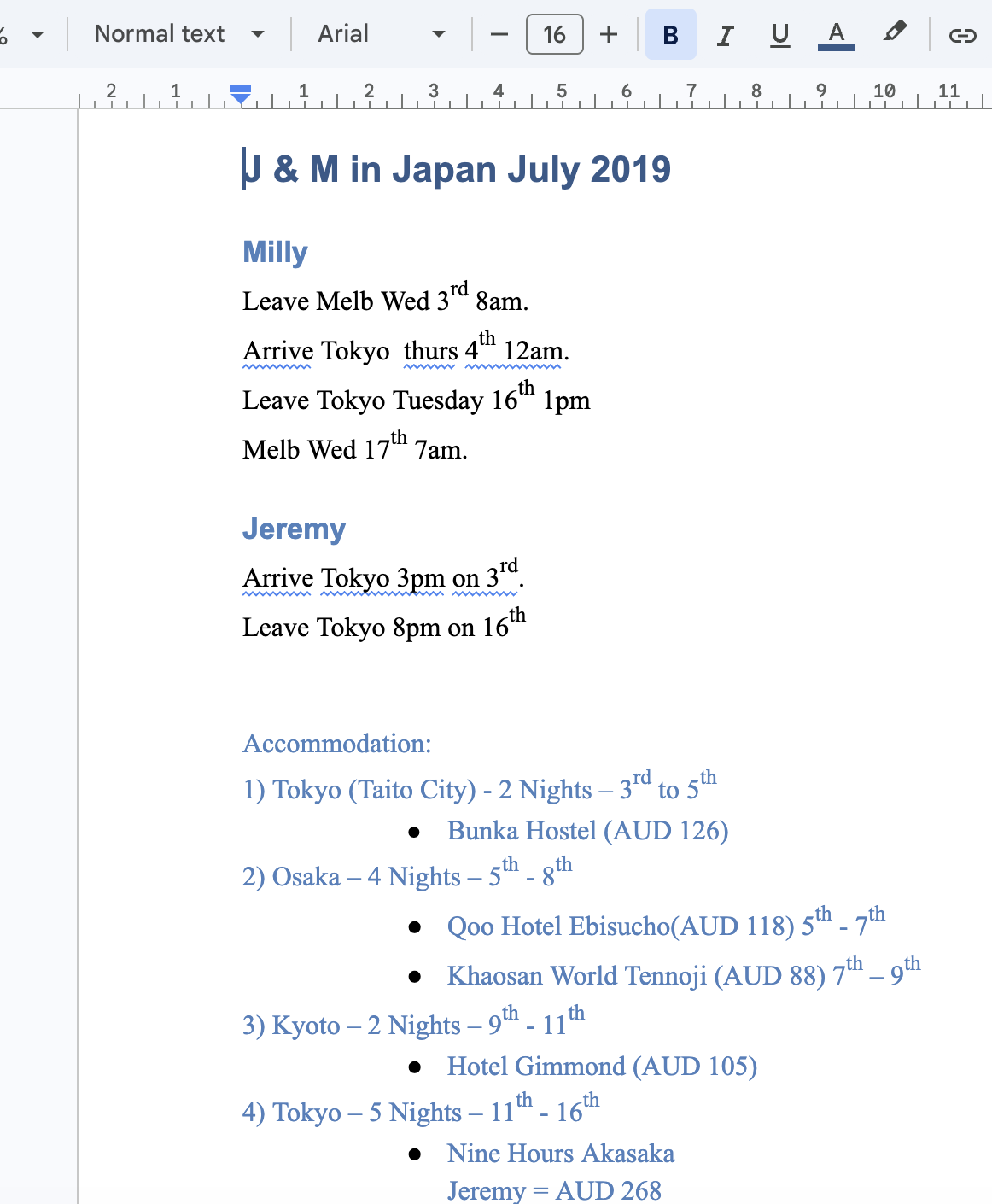
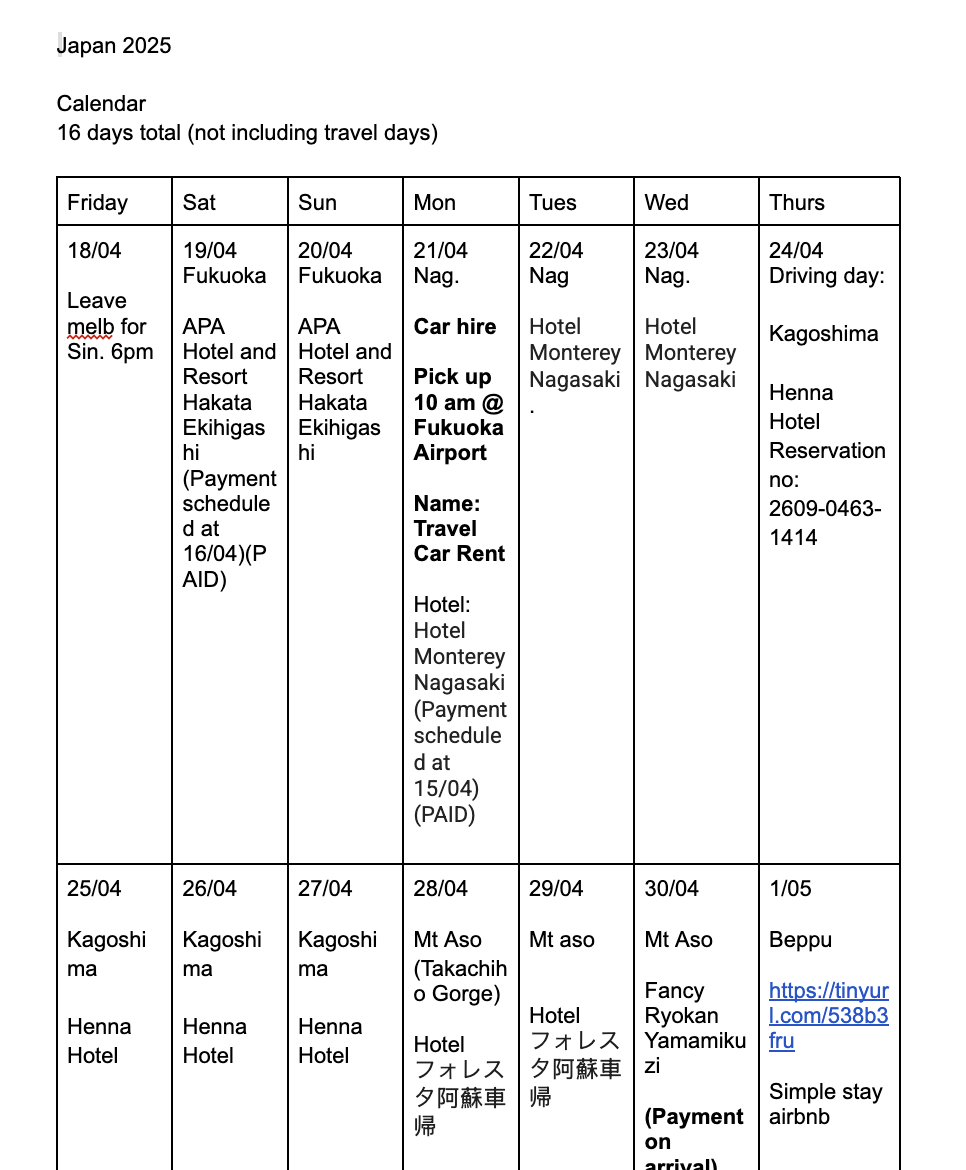
It was not pretty. At the time we thought it was acceptable. We did not even think to search for existing apps to help us. But here is the thing. Once we actually started traveling, we hardly looked at this document. The reason is simple now that I look back on it. It was ugly and unintuitive. We did not want to look at it because it added to our cognitive load instead of taking it away.
We had flights booked through one airline, a hotel through Booking.com, a couple of Airbnbs through a different platform, and a pocket wifi reservation from some website I found on Reddit. Every single one of those bookings lived in a different confirmation email. The Google doc was supposed to pull it all together, but keeping it updated meant copying details from five different emails into a wall of unformatted text. By the third day in Tokyo, we had stopped checking it entirely. We just winged it.
That trip was still amazing. Japan is hard to mess up. But I remember standing in Shinjuku station, completely lost, wishing I had a clear schedule I could pull up on my phone without squinting at a messy spreadsheet that was formatted for a laptop screen.
The spreadsheets multiplied
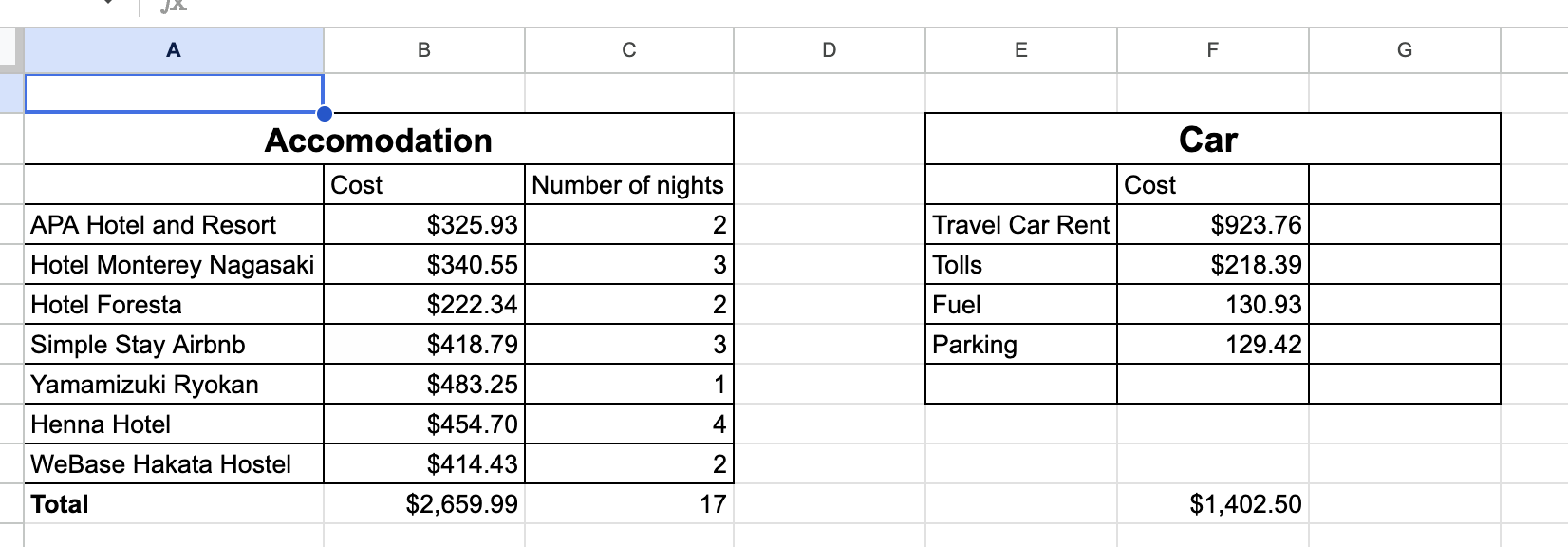
Over the next few years, we traveled more. Southeast Asia, Europe, New Zealand. Each trip came with its own planning setup, and somehow each one was worse than the last. We started using Google Sheets instead of Docs, thinking structure would help. It did not. We ended up with separate tabs for flights, hotels, activities, and costs. None of them talked to each other.
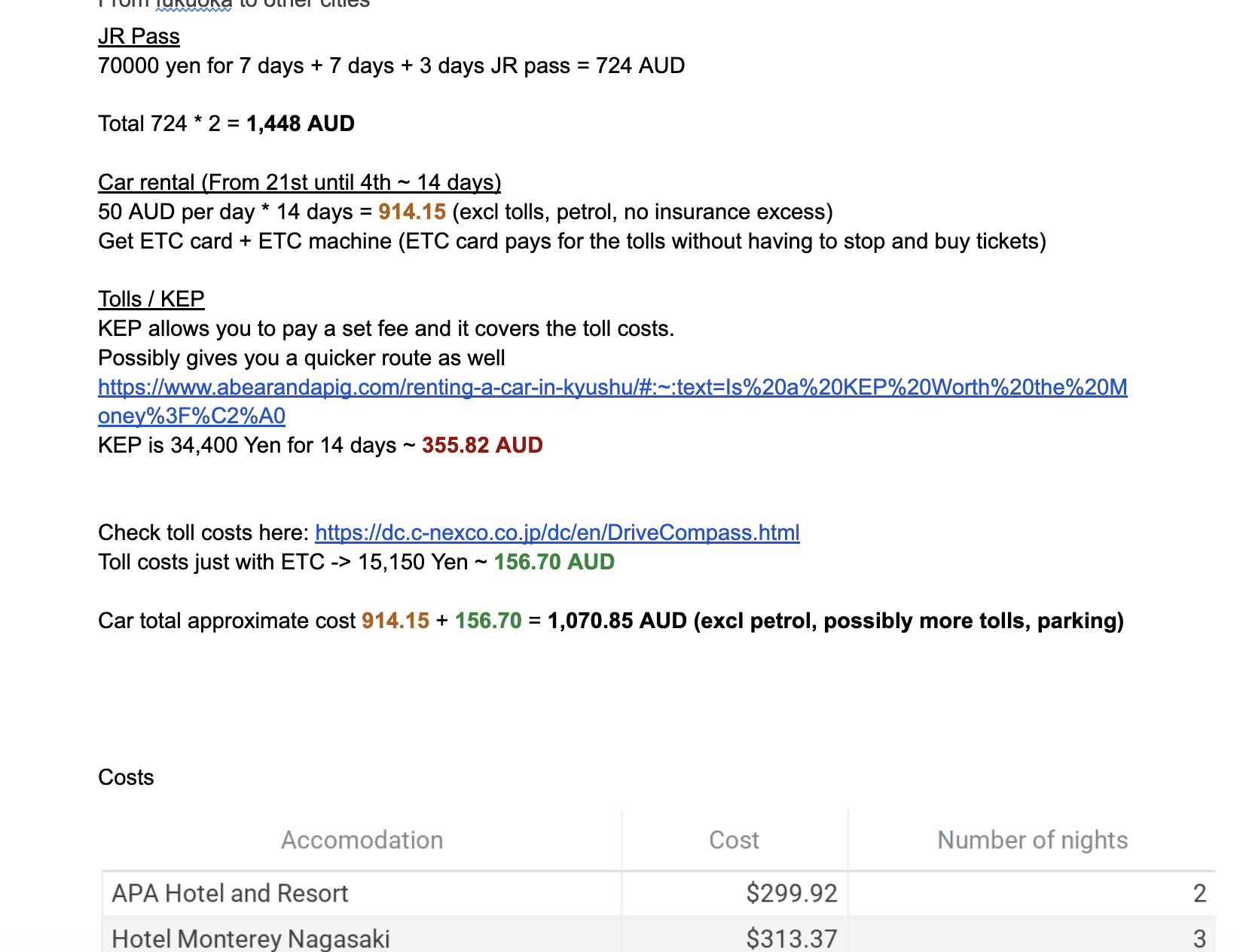
I tried colour-coding things. I tried embedding Google Maps links into cells. At one point I built a formula to calculate our daily budget based on the exchange rate. It was a hobby project masquerading as trip planning. I was spending more time maintaining the spreadsheet than I was actually researching things to do.
The worst part was sharing. My partner would ask a simple question like “what time is our flight on Tuesday?” and I would have to open the sheet, scroll to the right tab, find the row, and relay it back. Or I would send a screenshot, which was immediately out of date the moment I changed anything. Every trip ended the same way: the plan existed in my head, the spreadsheet was a graveyard of outdated information, and everyone else in the group was just along for the ride.
Why TripIt, Wanderlog, and Google Travel all fell short
One fine day in 2025, I was gearing up for yet another overseas trip. I started to realise that I actually dreaded the weekends. I dreaded the fact that I had to spend hours on research. I would open up a hundred tabs with Reddit, Google Maps, and a bunch of blogs that wrote a long winded essay before actually getting to the recommendations I was looking for. Yes, I am fully realising the irony as I write this blog post.
This time, I actually searched for travel planning apps. I tried a handful. TripIt, Wanderlog, Sygic, Google Travel.
TripIt was the most impressive at handling booking emails. You forward a confirmation and it pulls out the details. But the interface has not changed much in years, and using it felt like filling out forms in a government portal. Wanderlog looked better and had a proper map, but the moment I wanted to share my plan with my partner, it wanted her to download the app and make an account. That was a nonstarter. She would have ignored the link entirely. Google Travel I genuinely wanted to like, but it turned out to be a thin layer on top of Google Maps. No real itinerary builder. No offline support worth mentioning.
I kept looking. I tried a few smaller apps that I will not name because they were clearly abandoned. Dead links in the UI, loading spinners that spun forever. The travel planner app space is full of projects that someone started and then gave up on.
None of them did the thing I actually wanted, which is: import my bookings without me doing manual data entry, let me build a day by day plan, show it on a map, work offline when I am actually on the trip, and let me share the whole thing with a link instead of making everyone sign up. I could find apps that did one or two of those. Never all of them.
Building a free offline travel planner app
I decided I had enough. I teamed up with a mate of mine to solve this problem.
We kept asking ourselves what a travel planner would look like if it matched the way people actually plan. Not the way productivity apps think people plan, but the real version. Fifteen browser tabs open. A half-finished spreadsheet. Three group chat conversations about restaurants. A saved folder full of TikToks you will never look at again.
Offline was the first thing we agreed on. Your plans should live on your device. You should not need wifi to check what time your flight is or where your hotel is. We wanted booking import that actually works: forward your confirmation email and the app figures out the rest. A day-by-day view where you can drag activities around until the schedule makes sense. And sharing that does not require anyone else to create an account or download anything. Just a link.
Here is what ryokko does:
- Forward booking confirmation emails and the details get extracted into your travel itinerary automatically
- Drag and drop places and activities onto a day-by-day itinerary builder
- See everything on an interactive map inside the app
- Full offline travel planning on your phone, no wifi needed
- Share your trip plan with one link, no account or app download required
That is what ryokko is. We are two people building it in Melbourne, and it is not done yet. But we think we are getting close to something that we would actually want to use ourselves, which is kind of the whole point.
What we want from you
Right now, ryokko is in development. We are trying to build the best free travel planner app on the market, but we want real user feedback to get it right. We want your stories and your pain points.
What do other apps like Wanderlog/TripIt have that make them easy to use?
What makes them frustrating? What are the specific tasks that take up hours of your time?
What would you gladly pay someone or an app a small fee to handle, just so you can focus on enjoying your weekends?
Email me at hello@ryokko.xyz if you have any stories to share.
If you are curious about what we are building, read about how ryokko replaces the spreadsheet workflow or check out our latest development update.
Also, enter your email into our waitlist to claim your 6 months free of Pro. Be quick as we have a limited number of spots and it will not be open for long.